
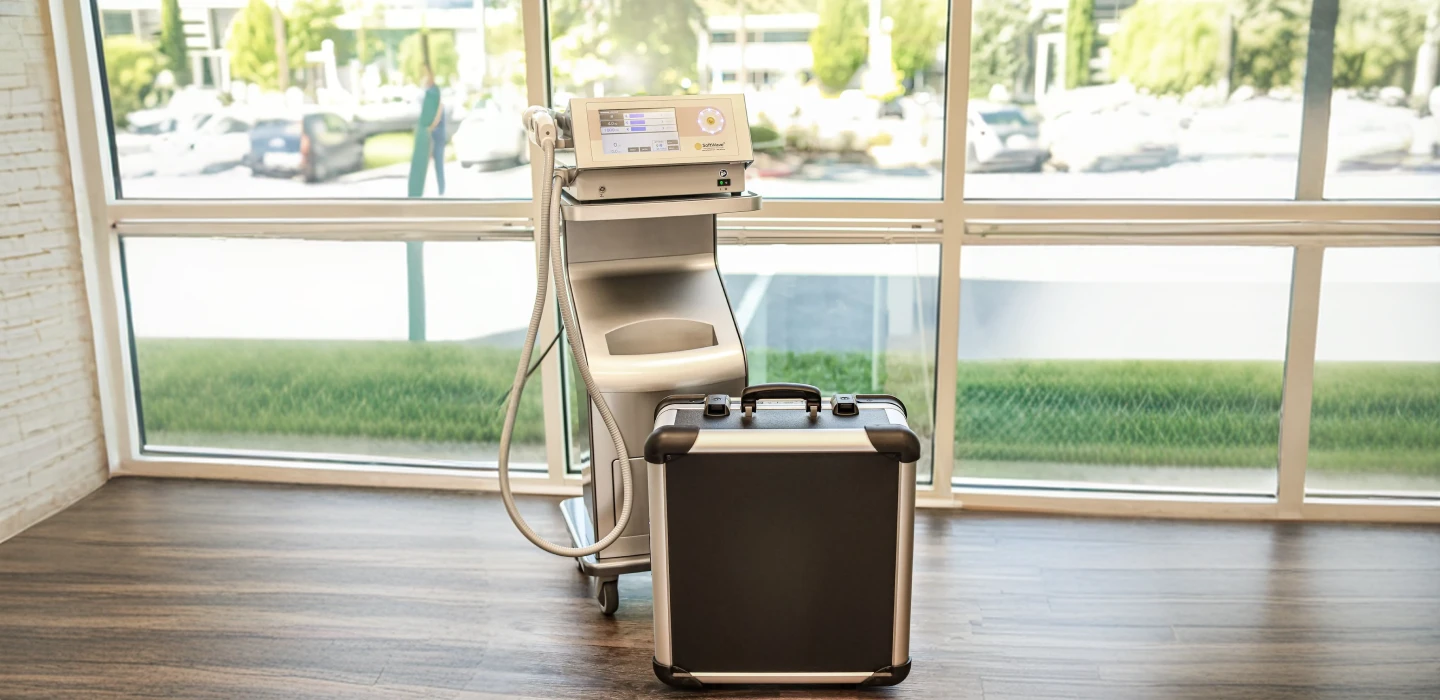
SoftWave® TRT · Ponte Vedra, FL
Rested it. Stretched it. Iced it. Still there?
You don’t need more rest, you need more blood flow. SoftWave® goes deep where healing stalled, FDA-cleared to boost local circulation.* No needles. No downtime. Feed the tissue. Restart the repair.
Stop managing symptoms. Start mastering movement.
First visit 30 minutes. Follow-ups about 15. No needles, no medication, no downtime.
Already a Keel patient? Book a SoftWave session
 01What’s the technology?
Tried a massage gun, a percussion tool or “shockwave” somewhere else, and the pain came back? Start here. SoftWave isn’t a stronger vibration. It’s a different kind of energy.
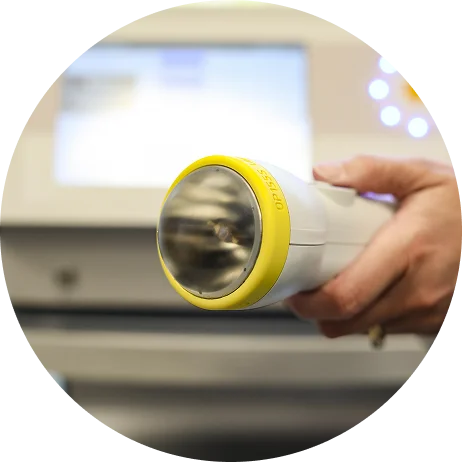
Inside the applicator, a high-voltage spark fires across a gap in water. That discharge creates an acoustic shock wave. This is electrohydraulic generation.
A reflector shapes the wave into a broad-focused field. Each pulse passes through gel and skin into muscle, tendon and connective tissue, covering a wide area instead of a single point.
Cells respond to mechanical force. It’s how tissue adapts to training. Researchers call it mechanotransduction: the pressure pulse becomes chemical signals inside and between cells (d’Agostino et al., 2015).
It also pinpoints the problem. Over healthy tissue, most people feel firm tapping. Over the irritated spot, it turns into a deep, familiar ache, which shows your provider exactly where to work. And it moves blood: SoftWave is FDA-cleared to increase local blood circulation, with no needles and no medication.*
Find out if SoftWave fits your problem.
 02Why is it different?
Plenty of clinics say “shockwave.” The devices behind the word are not the same. Some of the difference is marketing. The part that isn’t is physics: how the wave is made, how wide it spreads and how deep it reaches.
SoftWave generates its pulse electrohydraulically, from a spark-gap discharge in water. Most “shockwave” units use compressed air to fire a projectile into a metal tip, which produces a radial pressure wave. Researchers measuring one radial device found its pressure rise too slow to qualify as a shock wave in physics terms (Cleveland et al., 2007).
A reflector shapes each pulse into a broad-focused field, so the sore spot and the tissue around it are covered together. Point-focused devices concentrate energy into one small zone that has to be aimed precisely.
Radial pressure waves are strongest at the skin and weaken quickly with depth; in one study, high pressure stayed within about 2–4 cm of the tip (Cleveland et al., 2007). Compared with radial devices, SoftWave’s unfocused field is shaped to carry energy deeper into the tissue.
Comparison based on each technology’s published physics and research. Your assessment decides what fits you.
Not a pinpoint, a broad field. SoftWave’s unfocused pressure waves spread across the whole treated area and reach tissue about an inch or more below the skin. The aim: increase local blood circulation* and activate connective tissue* right where you need it.
And no, it’s not a massage gun. A massage gun is a motor-driven percussion tool working at the surface. SoftWave is an acoustic wave generated in water and delivered into the tissue.
03Why should I buy it?
You’ve done the sensible things. You rested it, stretched it, iced it, taped it and trained around it. It’s still there: the heel that bites with your first steps in the morning, the knee that aches on the stairs, the elbow that flares every time you grip a racket or club, the shoulder that wakes you when you roll onto it.
If one of these sounds like you, SoftWave is built for it:
Stop working around it. Find out if SoftWave fits.
04How does it fit in a treatment plan?
Nobody wants one good day. You want to run, train, play and sleep without thinking about it. Recovering tissue needs blood flow to get there. That’s why SoftWave at Keel is a plan, not a one-off appointment.
A tweak, a strain or a long season of overuse.
You stop using the area normally, so it moves and carries load less.
Less movement means less blood flow, and tendons start with a limited supply. Mature tendons are comparatively poorly supplied with blood, and the rotator cuff, Achilles and patellar tendons have zones with even less (Fenwick et al., 2002).
Without that supply, the tissue stops recovering the way it used to. Years later, the same spot still limits what you do.
In animal studies, shock wave treatment raised growth factors such as VEGF and produced more small blood vessels in treated tissue, including at the tendon–bone junction (Wang et al., 2003; Tepeköylü et al., 2013). Early research suggests this may be one way shock waves help restart the healing cascade across a course of care.
Animal and lab studies show shock waves can mobilize the body’s own progenitor (stem-like) cells and make stem cells more active (Tepeköylü et al., 2013; Schuh et al., 2014). It’s promising early research, not yet proven in human patients, and a big reason we deliver SoftWave as a series.
SoftWave is FDA-cleared to increase local blood circulation.* Inside a plan that loads the tissue again, it’s designed to kick-start the body’s own repair response. Here’s what it adds at each step.
| Phase | The goal | What SoftWave is aimed at | What the rest of your plan adds |
|---|---|---|---|
| 1Calm the area | Settle the irritated tissue so you can move again | Acoustic pulses over the sore spot. FDA-cleared for relief of minor muscle aches and pains.* | An exam that finds why it hurts, smart activity changes, and soft-tissue work when it helps |
| 2Restore flow | Get blood moving where it has stalled | FDA-cleared to increase local blood circulation.* Early research in animals suggests shock waves also drive new small blood vessel formation (angiogenesis). | Movement and mobility work that keeps circulation up between sessions |
| 3Load and rehab | Rebuild capacity so the tissue holds up | FDA-cleared for activation of connective tissue.* Animal and lab research suggests shock waves can activate the body’s own stem-like repair cells. | Progressive loading in the Performance Lab, plus structural chiropractic care for the mechanics behind the pain |
| 4Maintain | Protect the progress you’ve made | Sessions taper as you improve. Tune-ups only if you need them. | A home program, training adjustments and rechecks |
Where we use SoftWave most: the heel, the knee, long-standing tendon trouble spots like the Achilles, elbow and outer hip, and tight, achy shoulders. It’s always part of a plan with hands-on care and a loading program, never a stand-alone fix. We recheck at every visit and tell you straight how it’s going.
We take your history, examine the area and tell you plainly whether SoftWave belongs in your plan.
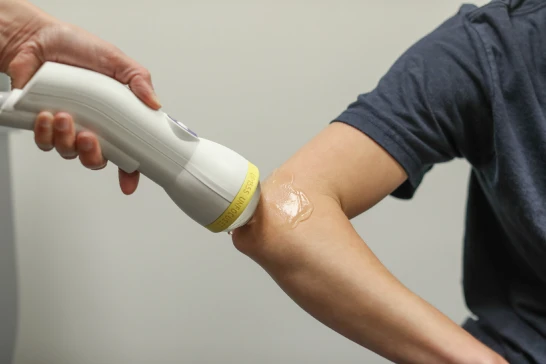
Gel goes on and the applicator moves across the area. Expect firm tapping and a deep ache over the sore spot. Intensity is adjusted to you.
You go straight back to your day. Some people notice mild soreness or redness for a day or so.
Sessions usually run about a week apart, giving tissue time to respond. We recheck every visit, and you’ll know what’s realistic for your problem before you commit to a plan.
Every SoftWave session at Keel is delivered by a licensed provider. Right now, that’s Dr. Nolan Gallagher, DC.
We look at structure, soft tissue and movement, so SoftWave goes after the cause, not just the sore spot.
Structural chiropractic care, dry needling and soft-tissue work, and active rehab in the Performance Lab, added only when they help. SoftWave can lead.
SoftWave sessions start at $195. Your plan and total are set at your assessment.
Keel is a direct-care clinic. We don’t bill insurance, so care decisions stay between you and your clinician. SoftWave is HSA and FSA eligible, and we provide an itemized superbill on request.
Start your plan with a 30-minute consult.
Keel Spine & Performance
Many devices sold as shockwave are radial pressure-wave units: an air-driven projectile strikes a metal tip, and the energy is strongest at the skin. SoftWave generates its wave from a spark in water and shapes it into a broad field that reaches into the tissue. Different source, different wave. We’ll explain exactly what we’re targeting at your consult.
No. SoftWave delivers acoustic pressure pulses. Therapeutic ultrasound is a continuous sound-wave oscillation. Different technologies, different effects.
Most people feel firm tapping and a deep ache over the sore spot. Intensity is adjusted to you. Some people notice mild soreness or redness for a day or so.
It depends on the problem and how long you’ve had it. Many plans run several sessions about a week apart. You’ll get a realistic estimate at your consult, not a guess.
We recheck every visit. If the tissue isn’t responding as expected, we’ll tell you and change the plan. That may mean adding other care or stopping SoftWave.
We screen at your consult. We don’t use SoftWave during pregnancy, over a known tumor, with a pacemaker or other implanted electronic device, with a bleeding disorder or blood thinners, over an infection or open wound, or for anyone under 18, and we avoid the lungs, head, spine and major nerves and blood vessels.
Usually, with some adjustments. We’ll tell you what to change for your injury and goals.
Yes, and we often pair them. SoftWave targets the irritated tissue; structural chiropractic care addresses the mechanics behind it. SoftWave can also stand on its own when that fits your plan.
We’re a direct-care clinic and don’t bill insurance. SoftWave is HSA and FSA eligible, and we provide a superbill for out-of-network claims.
400 Sterling Plaza Dr, Suite 406, Ponte Vedra, FL 32081, in Sterling Plaza on US-1. SoftWave is by appointment after a consult.